- Survey the general historical context
- Read the document through in one sitting
- Read it again noting relevant data
- Author
- What does the author tell about himself and his situation?
- How does the author describe himself?
- Recipients
- What does the author tell us about the intended readers/hearers?
- How does the author describe them?
- What can be known about the relationship between the author and recipients?
- Occasion
- What is the historical situation of the author leading up to the writing?
- What is the historical situation of the recipients leading up to the writing?
- What is it in the historical situation of the author and/or recipient that caused the text to be written?
- What situation(s) occasioned the writing of the text?
- Purpose
- What purpose was the author trying to accomplish in writing the text?
- instruction?
- motivation/encouragement?
- correcting?
- rebuking?
- etc.
- What is the intended result, which the author is trying to bring about in the readers' situation?
- What does the author want them to think?
- What does the author want them to do?
- Emphases
- What topics or themes are emphasized throughout the whole book?
- Are there any topics or themes that are the particular focus in certain sections?
- How is this book different/similar in emphasis from other books by the same author?
- Key Words
- Are there any words that are repeated/emphasized throughout the whole book? What are they?
- Are there repeated/emphasized words/concepts in certain sections? What are they?
- General flow of thought (outline)
- Note the general flow of topics throughout the book as a whole
- What are the larger groupings of topics/sections?
- How are these sections related?
- Is there a logical structure to the book in relating the arguments/sections?
- Make a general outline of the document
- Check your findings against secondary resources.
- Confirm the limits of the passage
- Review your general outline.
- Compare where a number of English translations break the paragraph or section.
- Make a final determination based on key words, conjunctions or shift of topic.
- Look for change of topic
- Look for major conjunctions
- Look for key words
- Check secondary resources
- Divide into a section that represents one unit of thought
- complete unit, not partial
- not multiple thoughts, can be summarized into a single overall idea or topic
- If the section is too large, further divide the section, If it is too small, combine two sections
- TOQ (Translation/Translation survey, Observation, Questions)
- Make a provisional translation OR read the passage in several different translations
- Make a list of places where translations have significant differences
- what you think are the exegetically significant differences in the translations
- what you think require further study.- not trivial stylistic differences or synonyms
- List your observations of significant items from the passage
- These can be about anything in the passage you think is significant,
- you should also begin to think about what the passage says and how it fits into the larger context and historical occasion and purpose.
- Things to look for- from Grasping God's Word
- Repetition of words- look for words and phrases that repeat
- Contrasts- look for ideas, individuals, and/or items that are contrasted with each other
- Comparisons- look for ideas, individuals, and/or items that are compared with each other. Look also for similarities.
- Lists- Note where the text mentions more than two items
- Cause and effect- There may be more than one effect from a single cause mentioned in the text
- Figures of speech- look for expressions that convey an image, using words in a sense other than the literal sense.
- Conjunctions- notice terms that join units, like “and”, ”but”, “for”. Note what they are connecting.
- Verbs- Note whether a verb is past, present, or future; active or passive; also look for imperatives
- Pronouns- Identify the antecedent for each pronoun
- Questions and answers- note if the text is built on a question and answer format
- Dialogue- note if the text includes dialogue. Identify who is speaking and to whom.
- Means- note if a sentence indicates that something was done by means of someone/something (answers “how?”). Usually you can insert the phrase “by means of” into the sentence.
- Purpose/result statements- These are a more specific type of “means,” often telling why. Purpose and result are similar and sometimes indistinguishable. In a purpose statement, you usually can insert the phrase “in order that”. In a result clause, you usually can insert the phrase “so that”.
- General to specific and specific to general- find the general statements that are followed by specific examples or applications of the general. Also find specific statements that are summarized by a general one.
- Condition clauses- a clause can present the condition by which some action or consequence will result. Often such statements use an “if…then” framework.
- Actions/roles of God- identify actions or roles that the text ascribes to God.
- Actions/roles of people- identify actions or roles that the text ascribes to people or encourages people to do/be.
- Emotional terms- does the passage use terms that have emotional energy, like kinship words (father, son) or words like “pleading”?
- Tone of the passage- what is the overall tone of the passage: happy, sad, encouraging, and so on?
- Connections to other paragraphs and episodes- how does the passage connect to the one that precedes it and the one that follows it?
- Shifts in the story/pivots- Is the passage being used as a key to understanding a dramatic shift in the story?
- Interchange- does the passage shift back and forth between two scenes or characters?
- Chiasm- does the passage have any chiastic arrangements, like a-b-c-d-c'-b'-a'?
- List any questions that you have about the passage, noting especially any ambiguities and difficulties.
- This can include anything you think is significant but should include
- any word meanings you are not sure of
- any historical references you need to study
- the relationship of words, sentences, and ideas
- especially questions in light of the occasion and purpose.
- Pay special attention to questions that will illuminate what the first readers would have understood
- Analyze Sentence Structure/Flow of Thought- i.e. what are the logical relationships between the sentences, and what is the point of each sentence?
- For Discourse- Make a sentence flow and arc of the passage
- Sentence Flow
- Introduction
- Aim- The aim of a sentence flow is to diagrammatically represent the syntactic relationships of a given passage. To aid the student to graphically see the main point and relationships of sentences
- Basic Structure
- The basic skeleton of a sentence is:
- Subject Verb (Direct Object)
- Using a formal equivalent translation is helpful.
- Basic Approach
- Put the skeleton of the sentence on the main line
- Put the modifiers underneath the words they modify
- Subordinate by indenting dependent clauses
- Highlight connecting conjunctions
- Method
- Divide the sentences and clauses
- Find the main verbs
- Divide into sentences
- Divide any dependent clauses
- Display the main sentences
- List the main verbs
- List the subject and any objects
- Display the modifiers in the proper position
- Display dependent clauses by subordination
- Participle clauses (“-ing” clauses)
- Infinitive clauses (“to –“ clauses)
- Relative clauses (“who…”, “which…” clauses)
- Adverbial clauses (Reason, Purpose, etc.)
- Isolate and Highlight coordinating conjunctions by placing them to the left
- Use color to highlight repeated words and continuing or contrasting themes
- Use the structure of the diagram to show lists and parallel thoughts
- hyperlink to Sentence Flow Handout

- Arc
- The possibilities
- Coordinate Relationships
- Series
- Def: Two statements that follow one after another, without much specific connection- “and”
- Eng: I listened to music. And I went to the store.
- John 1:1 In the beginning was the Word, and the Word was with God, and the Word was God.
- Key word markers “and”, no marker
- Progression
- Def: Two statements that follow one another, similar to series, but suggest movement and flow toward a climax- “and”
- Eng: I got on my bike and I went to the store.
- Romans 8:30 ...and whom he foreordained, them he also called: and whom he called, them he also justified: and whom he justified, them he also glorified.
- Key word markers- "and", no marker
- Alternative
- Def: Two statements that say the opposite, contrasting statements- “but”
- Eng: I went to the store. But I didn’t go to the park.
- Acts 28:24 Some were convinced by what he had said, while others did not believe.
- Key word markers- "but", "on the one hand...on the other hand..."
- Subordinate Relationships
- Restatement
- Means, manner, instrumental
- Def: The subordinate clause tells the means by which the main action is accomplished, answers the question “how?” - “by…”
- Eng: I went to the store by riding my bike.
- Matthew 6:27 Who of you can add a single hour to his life by worrying?
- key word markers- usually participle
- Comparative - manner
- Def: A statement is clarified by saying it is “like” another statement- “as, like”
- Eng: Just like a daredevil rides, I rode to the store.
- John 20:21 As the Father has sent me, I am sending you.
- key word markers- "like", "as", "just as"
- Negative Positive
- Def. Two alternative statements are contrasted, one is explicitly affirmed and one explicitly denied. “Not…., but…”
- Eng: I did not go to the Arcade, but I went to the store.
- Ephesians 5:17 Therefore do not be foolish, but understand what the Lord's will is.
- key word markers- "not...but..."
- General-Specific
- Def. A statement is elaborated by giving a specific example. “for example…”
- Eng: I bought some food. I bought bread. I bought soup.
- Ephesians 5:21-22 Submit to one another out of reverence for Christ. Wives, submit to your husbands as to the Lord.
- key word markers- "for example"
- Fact-Interpretation
- Def. A statement is explained by elaborating on some facet. “that is…”
- Eng: I wrecked my bike. I fell over the handlebars and rolled down the hill.
- 1 Corinthians 10:4 for they drank from the spiritual rock that accompanied them, and that rock was Christ.
- key word markers- "that is", "I mean"
- Question-Answer
- Def: A question (rhetorical or direct) is followed by the answer.
- Eng: Where is my bike? It is at the store.
- Romans 6:1-2 Shall we go on sinning so that grace may increase? By no means!
- key word markers- "?" (question mark and standard markers of question[who, what , when, etc.])
- Disclosure-Content - quoting, disclosure formula
- Def: The first statement is a formula stating that a source is about to be quoted. The second statement is the content of the quote.
- Eng: I said to my brother, “Let’s go ride bikes.”
- Matthew 4:7 Once again it is written: "You are not to put the Lord your God to the test."
- key word markers- "it is written", "Scripture says", "he/she said", "I think"
- Distinct Statement
- Ground -causal, reason
- Def. The reason or cause of a statement is given after the statement “because”
- Eng: I went to the store because I was hungry.
- Matthew 5:5 Blessed are the meek, for they will inherit the earth.
- key word markers- "for", "because"
- Inference -causal, implication
- Def: The reverse of ground, the reason or cause is given first “therefore”
- Eng: I have no food. Therefore, I am going to the store.
- 1 Peter 4:7 The end of all things is near. Therefore be clear minded and self-controlled
- key word markers- "therefore", "in conclusion", "for this reason"
- Cause-Effect -Result
- Def: relationship between one statement and automatic result “so that”
- Eng: I ate all the candy so that I felt sick.
- Acts 16:26 and suddenly there was a great earthquake, so that the foundations of the prison-house were shaken:
- key word markers- "so that", "resulting in", "so now"
- Conditional
- Def: Same as causal except one statement may or may not be true and the other depends on the first statement “if…then..”
- Eng: If the store has donuts, then I’ll be happy.
- John 14:15 "If you love me, you will obey what I command.
- key word markers- "if...then...", "whenever", "whoever"
- Purpose
- Def: gives the intent/perceived reason for an action with focus on the intended outcome whether that outcome takes place or not. “in order that”
- Eng: I went to the store in order to buy food.
- I Corinthians 8:13 I will never eat meat again, so that I will not cause him to fall.
- key word markers- "so that", "in order to/that", simple infinitive "to..."
- Temporal -time reference
- preceding
- Def: dependent clause takes place before the main clause. “after”
- Eng: I went home after I went to the store.
- John 4:43 After the two days he left for Galilee.
- key word markers- "after", "then"
- contemporary
- Def: dependent clause takes place at the same time as main “when”
- Eng: I had fun when I rode my bike.
- Luke 24:51 While he was blessing them, he left them
- key word markers- "while", "when"
- following
- Def: dependent clause takes place after the main clause “before”
- Eng: I tied my shoes before I rode my bike.
- John 4:49 come down before my child dies.
- key word markers- "before"
- Local -location reference
- Def: The relationship between an action and the place where this action happened or will happen.
- Eng: Wherever there is a steep hill, I will ride my bike.
- Matthew 24:28 Wherever there is a carcass, there the vultures will gather.
- key word markers- "where", "there", "wherever"
- Situation-Response
- Def: The relationship between a circumstance and a person’s reaction to it. The reaction is not a necessary result.
- Eng: My bike got a flat. I sat down and cried
- John 7:21 I did one miracle, and you are all astonished.
- key word markers- "and", "and then" mostly logical, not grammatical relationship
- Support by Contrary Statement
- Adversative -concessive
- Def: the statement is affirmed in spite of apparently contrary information “even though”
- Eng: I went to the store even though I had no money.
- Ephesians 2:5 even when we were dead in our transgressions, [He] made us alive together with Christ
- key word markers- "even though", "although", "but", "rather"
- Situation-Response
- Def: The relationship between a circumstance and a person’s reaction to it. The reaction is not a necessary result. In this case, the reaction is not necessary, but seems to go against the expected reaction.
- Eng: I offered Joey a ride on my bike, but he hit me!
- John 7:21 I did one miracle, and you are all astonished.
- key word markers, "and", "but"
- Relative Clause
- Simple relative -clarifying, defining
- Def: A complete sentence functions as an adjective by using the relative pronoun- there is really only one statement being made “who”, “which”
- Eng: I went to the store which is at the end of the street.
- Galatians 3:10 All who rely on observing the law are under a curse
- key word markers- relative pronouns "who", "which", "that"
- Progressive relative -clarifying, defining, but implies a forward movement of thought
- Def: A complete sentence functions as an adjective by using the relative pronoun- In this case, it has the form of a simple adjectival idea, but it really functions to move the argument forward “who”, “which”
- Eng: I saw my friend, who ran after me.
- Colossians 1:13-15 ...into the kingdom of the Son he loves, who is the image of the invisible God
- key word markers- relative pronouns "who", "which", "that"
- hyperlink to Flow of Thought Handout
- hyperlink to How Propositions are Related Handout
- The process
- Working from your sentence flow, determine how many propositions there are in your passage.
- Write out the propositions on the lower part of a paper each on a separate line and numbered, keeping with the verse numbering if possible (e.g. 12a, 12b, 13, 14 a, 14b, 14c, 14d, etc.).
- Draw a horizontal line. Draw an arc for each proposition and place its number beneath it.
- Begin with the first arc and try to determine its relationship with the second. (Not necessarily the first in verse order, but the first you will work with. Your sentence flow should tell you which propositions are the most closely related. Start with these.) Look for key words (especially conjunctions), logical relationships and context to help determine the relationship.
- Place the appropriate symbol for the relationship in its tentative location. It is often helpful to draw lines in different levels to show independent or subordinate relationships as you go along. (Use pencil so that it can be erased and reworked)
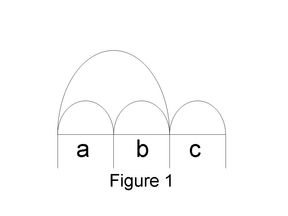
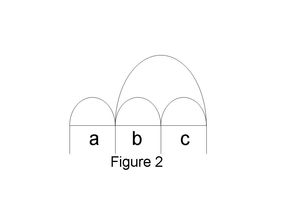
- Follow this procedure for each arc. Try to determine how it is related to that which follows it and precedes it. At this stage you need to be asking and tentatively answering whether each proposition is related more closely with the arc before or the arc after. For instance, if proposition b is related more closely to proposition a than to proposition c, it would be arced as in figure 1- showing that it is related to a, and that c is related to the whole of a-b. If b is more closely related to c than to a, it would be arced as in figure 2.
- Start with the lower levels. When you have connected all the lower levels, describe the connection between larger groups of arcs. The larger groups are connected with the same relationships and symbols. Continue asking the connection between all groups until every arc is connected into one overarching arc. Always begin with the lowest levels and work upward.
- Readjust and recopy your arc when you are satisfied you have adequately described all the relationships.
- Make a Teaching Outline from the arc.
- hyperlink to Arcing Handout
- For Narrative- Make a storyboard of the passage
- Nature of Narrative
- Narratives are not discourse
- Three Levels of Biblical Narrative
- Bible's whole plot line
- OT and NT people of God
- Individual stories- large and small
- History, not Fiction- shared experience
- Interpreted history
- It is selective, not every fact is told
- It is told from a point of view
- It is told for an occasion and for a specific purpose
- e.g. Kings written at the start of the exile to show that Israel deserved exile
- e.g. Chronicles written at the end of the exile to show that God was still with Israel
- Theological/prophetic hisory
- Often onmiscient, from a God's eye view, knows what characters are thinking etc.
- Takes sides- painting some characters and actions as right and wrong
- Takes a moral stand on issues- explaining that some characters/actions are godly/ungodly
- Carefully crafted literature
- pay attention to the story that is told
- also pay attention to the way the story is told
- look for narrative techniques that show the point of the story
- Often subtle
- Often succinct- no/few superfluous details
- Principles of interpretation
- Parsimony- simplest explanation is the best
- Read a few times and listen to your emotions- guts
- Rejoice with the good
- Be angry with the evil
- If you interact in this way, you get it
- Look for Narrators clues
- Structural features
- Setting
- Physical
- Symbolic setting- certain things happen on mountain tops- meet with God, certain things happen at a well, etc.
- Temporal- time descriptions are usually important
- Cultural- cultural features
- Characterization- protagonist, antagonist-
- Direct description- rare, but important- Saul is biggest, Ehud is left-handed
- how do other characters respond to them, describe them- love them or hate them- cf. Boaz describing Ruth as a woman of character
- their own words and thoughts
- how they describe themselves
- know them by their actions
- always evaluate their actions within a moral context- their own moral context, not ours
- Plot- quest-
- centers around conflict
- physical conflict
- conflict between characters
- moral conflict- should the character do this or not
- Scene-
- usually 2 or 3 characters- simple,
- moves between scenes to develop complex relationships
- Climax- resolution?
- Point of View-
- where is the narrator looking from?
- Sometimes God’s eye view, knows all,
- sometimes in suspense with the characters
- Dialogue- important tool of narrator
- Key feature of Biblical narrative- esp. OT
- Often summarizes narrative- by the words
- Clue to characterization- what the people say
- Clue to the point the narrative is making often in the dialogue- writer says the moral in the words of the characters
- Repetition- key words- Chesed in Ruth
- Patterns- Gen 1-11
- Comparison, Contrast and Analogy-
- Ruth and Orpah,
- Boaz and kinsman
- Ambiguity and Omission- Rebekkah does not die,
- Narrated time- Fast forward and slow motion
- Jumps in space
- Interruptions- flashback, comments
- Structural symmetry
- Intertextual allusions- Ruth comparison to Judah and Tamar
- Repetition and cross textual allusions- 2 patriarchs say wife is sister, Abraham and Sarah
- Theological implications-
- Who is God?
- What is He doing in the stories?
- Read carefully looking at details and ask why they are there- look at the fish
- Line out verbs- that is- list the events as the author lists them
- Highlight dialogue
- divide into scenes, note interruptions
- God is always the hero
- Storyboarding
- Concept
- “A storyboard is a graphic, sequential depiction of a narrative. Students recall major events of the story, then illustrate the events in the squares provided”
- Used in movies to plan scenes
- Used by us to describe/draw narrative
- not draw pictures of the way we would film it
- but visually display the way the author tells the story
- Can be narrow in scope
- for smaller narrative
- look at details
- Can be broad in scope
- for large narrative
- group large chunks
- big picture
- List Actions, display actions
- Main actions
- Sideline actions- parenthesis type of actions
- Highlights Dialogue
- Highlights Narrative clues
- Process
- the scope
- Detailed, small scene
- Broad, larger scope
- What to draw
- Actions
- Main Actions
- Sideline Actions
- Dialogue
- Narrative Clues
- Setting
- Characterization- color code different characters
- Key words
- Comparison, allusion
- etc.
- Mark anything out of the ordinary
- How to draw
- Use whichever method works for you
- A suggested method

- Put background information at the top of the frame
- Put main actions in the center of the frame
- Put sideline actions lower in the frame
- Put narrative clues and anything that needs highlighting at the bottom of the frame
- Put dialogue to the right of the frame
- hyperlink to storyboard handout
- hyperlink to blank storyboard
- For Poetry- analyze the parallelism and make an arc of the passage
- Restate the argument and major points of your passage in your own words.
- Analyze the Grammar and significant words
- Study Words
- Determine which words bear the need for further study
- Choose the words whose meanings are not obvious
- words that you are not sure of the meaning
- words that are obscure or foreign
- words that can have more than one meaning i.e. ambiguous
- Choose key words
- theological words
- repeated words
- theme words of the passage
- Choose words that are translated in diffeent ways
- not just synonyms or stylistic differences in translation
- words that have significantly different meaning in different translations
- Choose words that have important functions in the sentence
- Verbs- the main action words are usually worth studying
- Don't forget conjunctions- they usually have important functions, especially less frequent conjunctions
- Don't forget prepositions- they usually have important function and can have a variety of meanings/connotations
- Choose whatever words interest you- those words that you are interested in studying
- Determine the range of possible meanings for the word
- Word meanings
- Words often have a range of meanings
- Words don't always mean the same thing every time they are used
- In any context, a word has a narrow point of meaning from the wider range of possible meanings
- Words change meaning over time
- At any time, the range of possible meanings is smaller than the total range of what it meant over centuries of time
- Use research tools to find the range of meanings
- Concordances- lists every occurence of the word so you can look at the ways in which the word is used
- Lexicons- lists the definitions of a Biblical word (the original language word), grouped into categories of meaning
- Bible Dictionaries- lists the definitions of a Biblical word (English language word), often grouped into categories of meaning
- (Don't use modern English dictionaries, (e.g. Websters dictionary). They define what the word means to modern English speakers, not what the word meant to the original hearers, and there is often a significant difference of shades of meaning)
- Bible Encyclopedias- like Bible Dictionaries, but in much more deptch
- Theological Wordbooks- much more in depth than lexicons and dictionaries (usually based on original languages). Traces the meaning of words throughout the history of the language, especially the meanings they had in the Biblical uses of the word. Use caution with wordbooks because not every meaning a word ever had s a possible meaning in the Biblical time period or context.
- From these tools, review the possible meanings of the word.
- Determine the precise meaning by the word’s use in context
- words take their meaning in context
- let the context rule out certain possible meanings of the word which don't make sense in this context
- let the context tell you which possible meaning of the word was probably intended by the author
- Study Grammar
- For those translation differences which you suspect are based on grammatical decisions research the grammar
- Study that which you think is important for understanding the passage
- Be thorough, the more work you do now, the better you understand the passage, and the easier for later work
- Don't be over-thorough, don't study every word, but only those that are unclear and/or will be helpful to understand the passage
- How words relate
- Hyperlink to English Grammar Review
- Words serve a specific function in a sentence
- verb- action word
- subject- what does the actioin
- object- what receives the action
- modifiers- words/phrases that explain/describe/elaborate the verb, subject, or object
- Words sometimes directly modify (define, explain, describe and elaborate) other words
- ask the function of words
- What is its function in the sentence?
- What words modify what words?
- Which words refer to which words?
- How do phrases relate? What is the function of a phrase in a sentence?
- Research and display the grammar
- for Nouns- Is it the subject, object, other function in sentence?
- for Pronouns- What noun does it refer to (antecedent)? What is its function in sentence (subject, object, etc.)?
- for Verbs- What is the significance of the tense? Voice? Mood? Aspect? What type of action does it describe? What is the subject? object?
- for Participles- What does it modify? Does it function as a noun, adjective, or verbal (action) idea? How does it add to the sentence?
- for Infinitives- What does it modify? Does it function as a noun, adjective, or verbal (action) idea? How does it function in the sentence? What does it add to the sentence?
- for Adjectives- What does it modify? What does it say about the word, sentence
- for Adverbs- What does it modify? What does it add to the sentence?
- for Conjunctions- What does it connect together? What type of conjunction is it? What is the nature of the connection?
- for Prepositions- What is the object of the preposition? What does the phrase modify? What does it add to the sentence?
- Consult the grammar discussion in the commentaries.
- Research the specific historical/cultural background
- Determine if your passage is primarily Jewish and/or Greco-Roman
- Look up key words, places, persons, events, institutions and/or concepts in Background studies and Background commentaries
- Try to research historical/cultural references until you understand what the original readers would have understood
- [Specific steps for different genres]
- Go back and check/revise your sentence structure/flow of thought based on grammar/word/background studies, etc.
- Consider the broader Biblical/Theological contexts
- Determine how the meaning of your passage compares to and contrasts with other biblical material that deals with the same or similar issues
- Check cross references in Study Bibles or Topical lists
- Check Indexes in Biblical and Systematic Theologies
- Research the secondary literature
- Compare your finding with commentaries
- Check for journal articles using the Periodical Index, New Testament Abstracts or Old Testament Abstracts
- Assess, compare and weigh different arguments and new evidence
- Adjust your findings to take your new knowledge into account.
- hyperlink to class handout (pdf format)